



A fabric that used to cost a fortune
Velvet earned its reputation the hard way. According to The Metropolitan Museum of Art, velvet is a pile fabric: extra threads are pulled up over thin rods to form loops, and those loops are cut to create that dense, soft surface. It was slow work that swallowed far more silk than a flat cloth, and between about 1400 and 1600 the workshops of Venice, Florence and Genoa turned it into the most coveted textile in Europe. Weavers could train for seven or eight years before they were trusted with it.

The Victoria and Albert Museum describes Renaissance silk velvet as one of the most expensive and luxurious textiles of its time, and notes that velvet weavers were paid more than other silk weavers. In several places, laws even spelled out who was allowed to wear it. So for centuries velvet meant one thing: this person can afford it, and tonight is important.
That's the inheritance. Today velvet is woven from cotton, viscose and blends, and a good blazer costs about the same as any other good blazer. The price changed. The idea that it's only for big nights stayed behind, like a guest who missed the announcement that the party was over.
Why velvet looks the way it looks
Velvet doesn't need an occasion. It needs something plain next to it.
Here's the part nobody explains at the store. That cut pile is thousands of tiny fibers standing upright. Light falls into them instead of bouncing straight back, which is why velvet colors look deeper than the same color in a flat fabric. The Met's essay points out that the surface changes as the cloth folds and the light hits it from different angles. A black velvet blazer is never just black; it's black with shadows and highlights built in.
 Day
 Night
That depth is what reads as 'dressed up.' And it's also the reason velvet is so easy to wear by day: all you have to do is put it next to something that does the opposite. Denim, cotton poplin, a ribbed knit, plain leather. Flat, matte, everyday textures calm the velvet down, and the velvet makes the everyday pieces look chosen.
The frumpy fear, and why it's backwards
If you've ever read an 'after 40, never wear' list, velvet tends to show up twice: once as 'too young' (the crushed velvet of the nineties) and once as 'too old' (grandmother's sofa). When one fabric gets both accusations, the fabric isn't the problem. The list is.
 Shoulder
 Length
 Cuff
What actually decides how a velvet blazer looks on you is fit, not age. Three things to check on the body you have today. The shoulder seam sits at the edge of your shoulder, because velvet adds a little visual weight and a dropped shoulder doubles it. The length ends at the hip or just below, so the eye gets one long line. The sleeve shows a bit of wrist or cuff; that sliver of shirt or skin keeps the fabric from swallowing your arms.
The YB Method, applied: velvet on a weekday
By day, by night and in any season. That's the versatility test, and a velvet blazer passes it the moment you stop saving it.

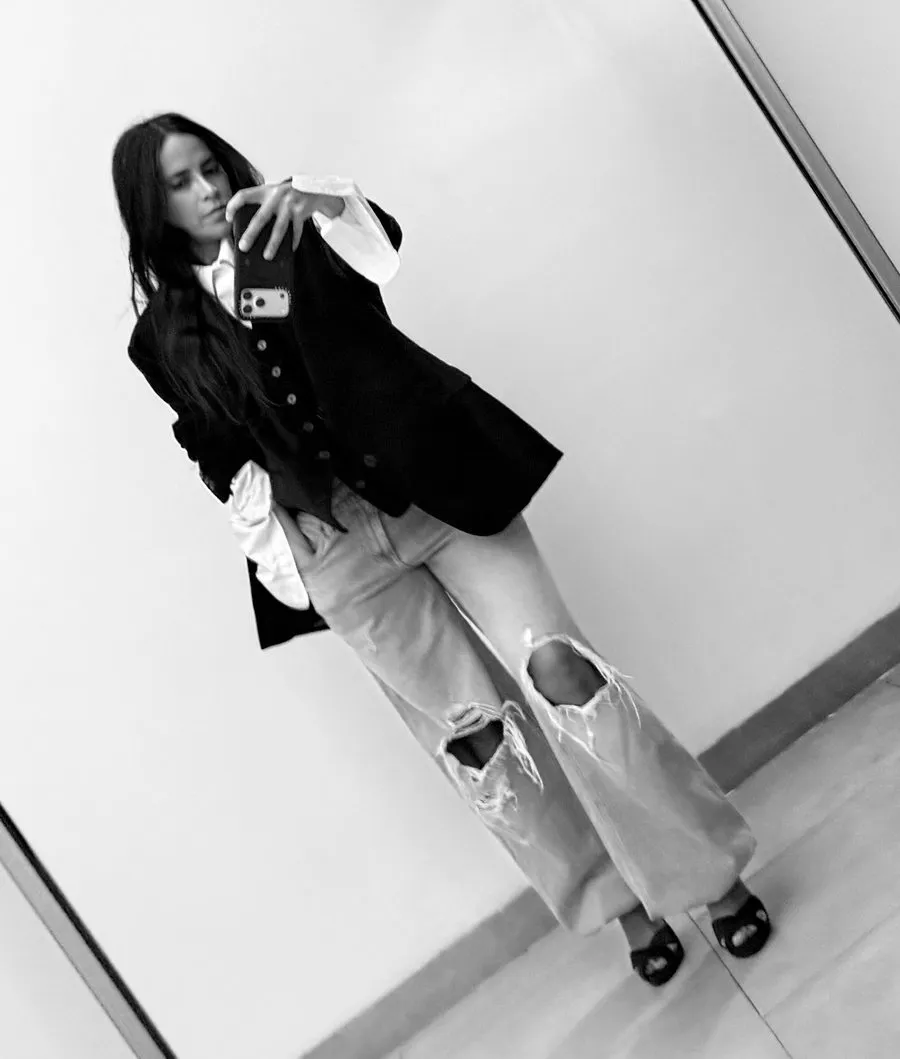
1. With jeans and a white shirt. The fastest way to take velvet off its pedestal. Light, relaxed denim underneath, cuffs out. 2. Over a printed dress. Pick the blazer in a color that already lives in the print; burgundy over a dark floral looks deliberate. 3. Over a long black dress with boots. Matte dress, velvet on top, a heavier shoe. Office to dinner without changing. 4. Over a slip dress. Satin shines and velvet absorbs, so the two textures balance each other. Add an ankle boot and it stops being 'evening.' 5. With a vest underneath. Three layers, one color family, and the velvet is the only texture talking.
One star only, the first of the 10 Golden Keys, applies here too: when the velvet is on, let it lead. Keep the rest plain in texture, even if the color is strong.
Shopping smarter for velvet
Since the point is to wear it fifty times instead of twice, buy for that. Look for a short, dense pile: run your hand against the grain, and it should feel thick, not thin and shiny. Cotton or cotton-blend velvet holds a tailored shape better than very stretchy versions. A full lining helps it slide over shirts and knits. And choose a deep color you already wear: black, burgundy, bottle green or navy all behave like neutrals in velvet.
Then do the math that matters. A blazer worn only in December gets two or three outings a year. The same blazer worn with jeans in October, a dress in February and a T-shirt in April earns its place in your closet. The relative who only came for the holidays? Turns out she's great company on a Tuesday.
Frequently asked questions
Can you wear velvet during the day?
Is velvet only for winter and the holidays?
How should a velvet blazer fit after 40?
What do you wear under a velvet blazer?
What should I look for when buying a velvet blazer?
Sources and further reading
- The Metropolitan Museum of Art — Renaissance Velvet Textiles (Melinda Watt, 2011)
- Victoria and Albert Museum — Silk velvet furnishing fabric, 1570–1600
- Selvedge Magazine — Sumptuous Velvets
Read next
The blazer is not a uniform: a short history of a misunderstanding →Neon has no age: the color theory nobody taught you →The poncho is not a hideout: the theory of volume after 40 →A logo is an ad: what brand prominence says about you →Sweet and tough: the theory behind a dress and a leather jacket →Beauty is not pain: why comfort is a style decision →Leopard is a neutral: the history of fashion's most misjudged print →The black vest: five ways to wear the garment a king swore would never change →White doesn't expire in September: the truth about no white after Labor Day →The feather skirt is not just for parties: one star piece, three ways to wear it →Leopard on your feet: how to wear leopard print boots with almost everything →One loud piece, quiet basics: how to wear a statement coat without the costume effect →The trench coat is not a raincoat: London and Paris reinvented it (and it's already in your closet) →The corset doesn't squeeze you, it holds you: how to wear one all day without suffering →Loafers are not just for men: five ways to wear them with everything →Turn off the color and texture turns on: what black and white reveals about your style →When your outfit owns every corner: simple is not the same as invisible →Spring 2027 runway trends are already in my closet: what London, Milan and Paris showed →Tailoring that hugs: the black suit, the vest and Milan's cinched waist →The high-low hem is back: my white ruffled dress and London's runways →Leopard is the neutral of 2027: Paris just confirmed it →The evening jacket, now by day: Milan and Paris agree →