
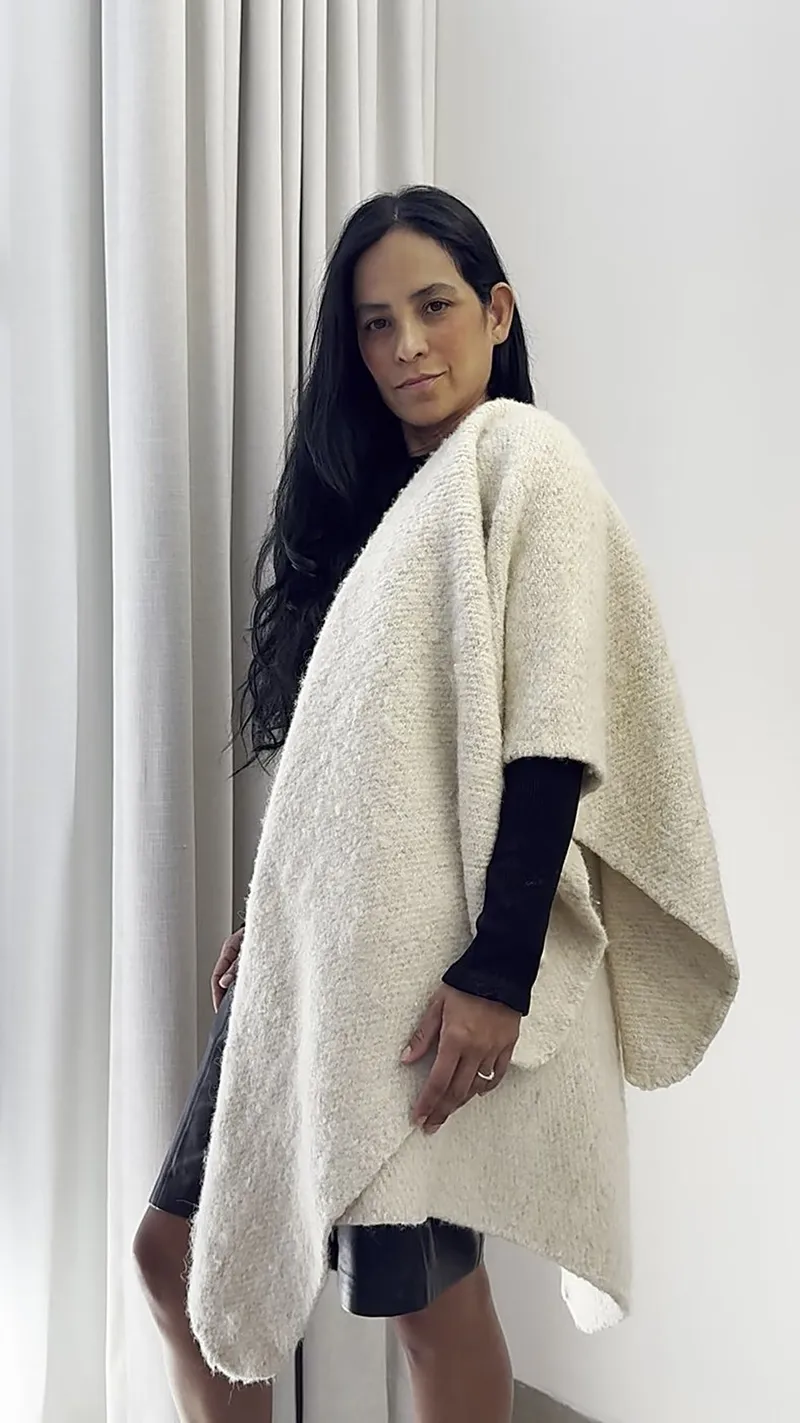
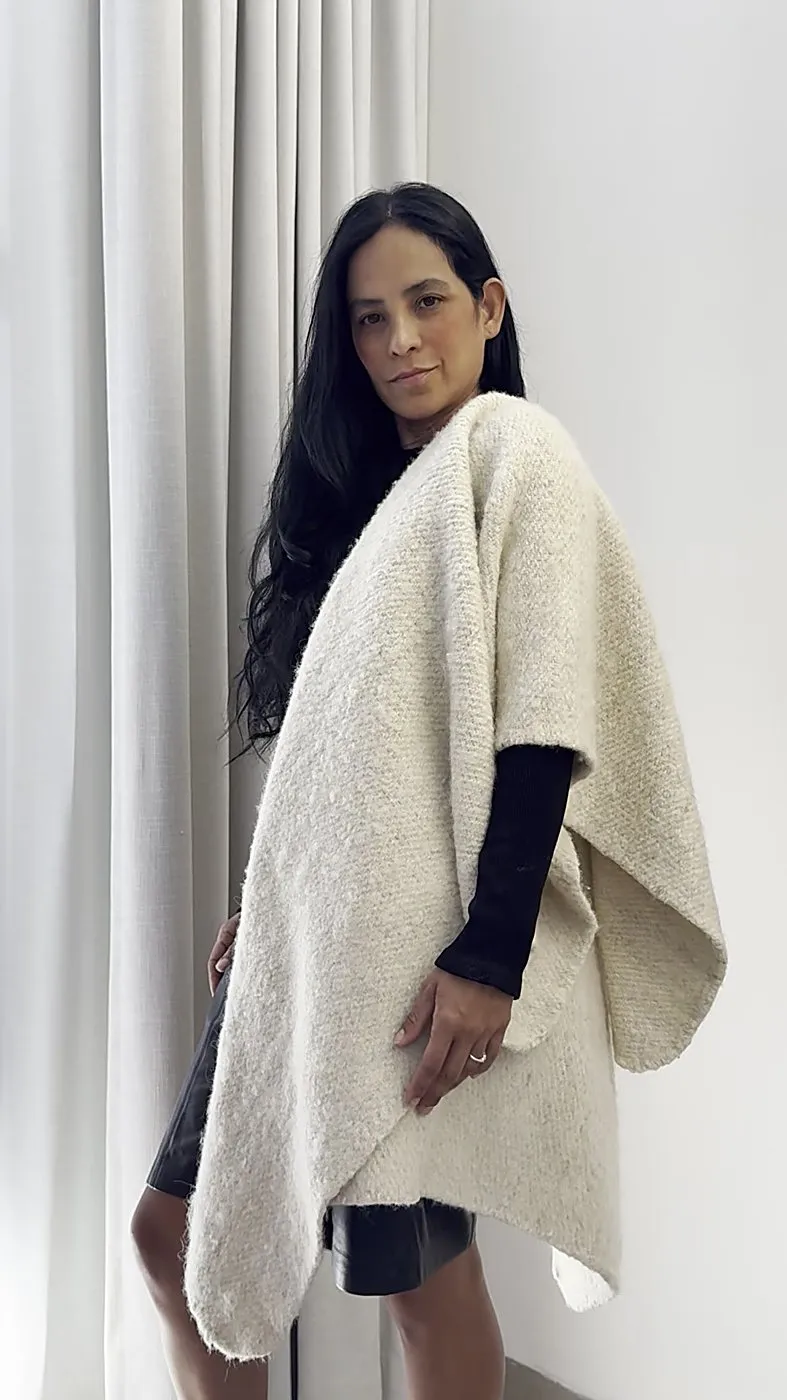
A garment older than the rule against it
Let's start with some perspective. The poncho is not a trend. It's one of the oldest garments in the Americas. Ponchos evolved from a pre-Columbian tunic worn in the southern highlands of Peru, Bolivia and Chile, and the Mapuche people of present-day Chile and Argentina popularized the poncho in the 17th century because it was perfect for riding and fighting on horseback. In other words: the poncho was designed for people who needed to move, work and win. Hiding was never on the job description.
The idea that loose clothing is something you wear to cover up is much younger, and it has a very specific villain: the waist. For most of Western fashion history, a woman's silhouette was measured by how small her middle could be made to look. Anything that didn't announce a waist was read as giving up.
What Balenciaga knew about volume
Volume doesn't hide you. Skipping the reference point does.
Then came 1957, and Cristóbal Balenciaga sent out the sack dress. It hung from the shoulders like an envelope and ignored the waist completely. The press panicked. One British tabloid famously complained that it was hard to be sexy in a sack. And yet, as the Victoria and Albert Museum notes, the dress was radical precisely because it let the body breathe instead of squeezing it into an hourglass.
Here's the part people forget: the Met's essay on Balenciaga points out that neither the sack nor the chemise had a waist, yet both were considered universally flattering and were copied at every price point. How? Because Balenciaga never let volume float without a plan. A strong shoulder, a precise neckline, a hem that landed exactly where it should. The eye always had somewhere to rest.
That's the whole secret. Volume is not the problem. Volume without a reference point is the problem. When nothing on your body tells the eye where you are, the fabric becomes the main character and you become the coat rack.
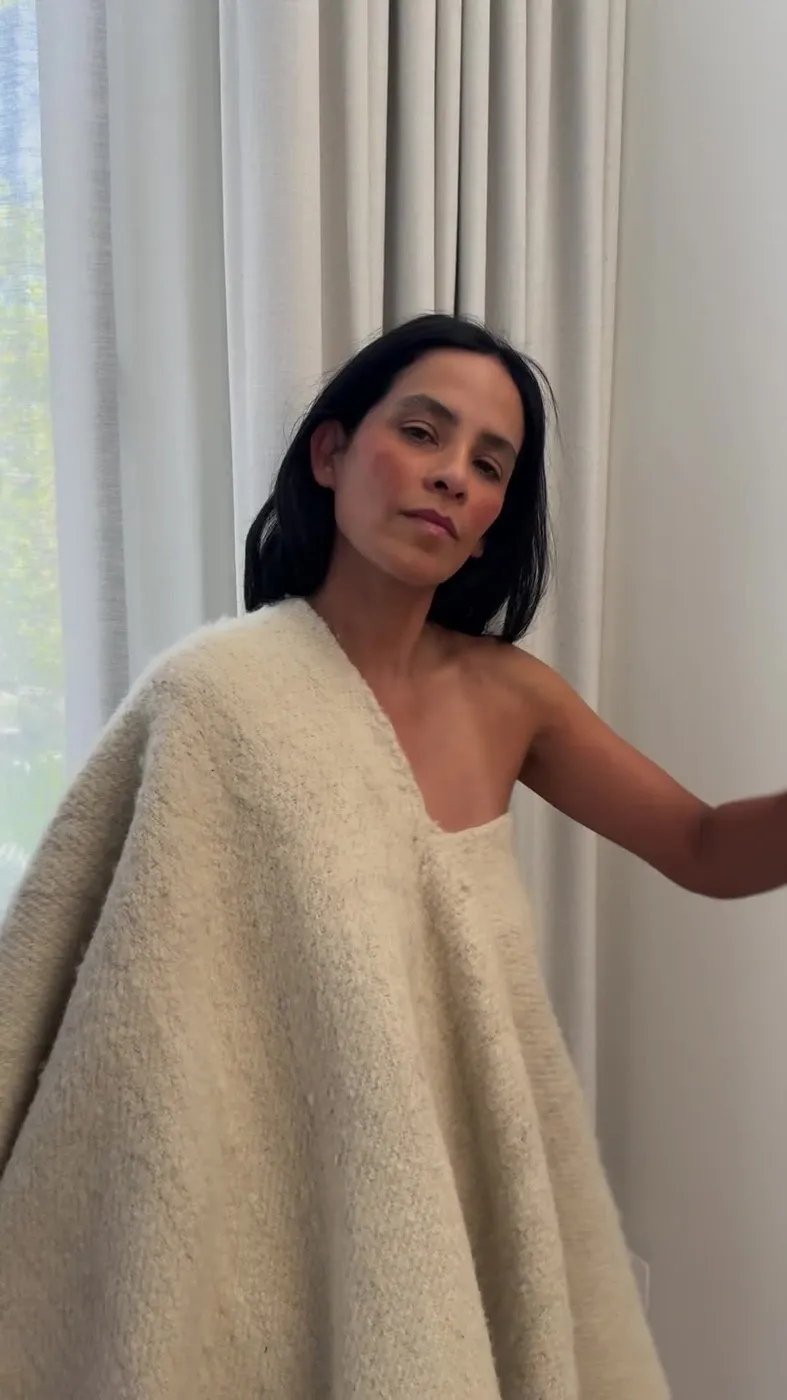 One shoulder
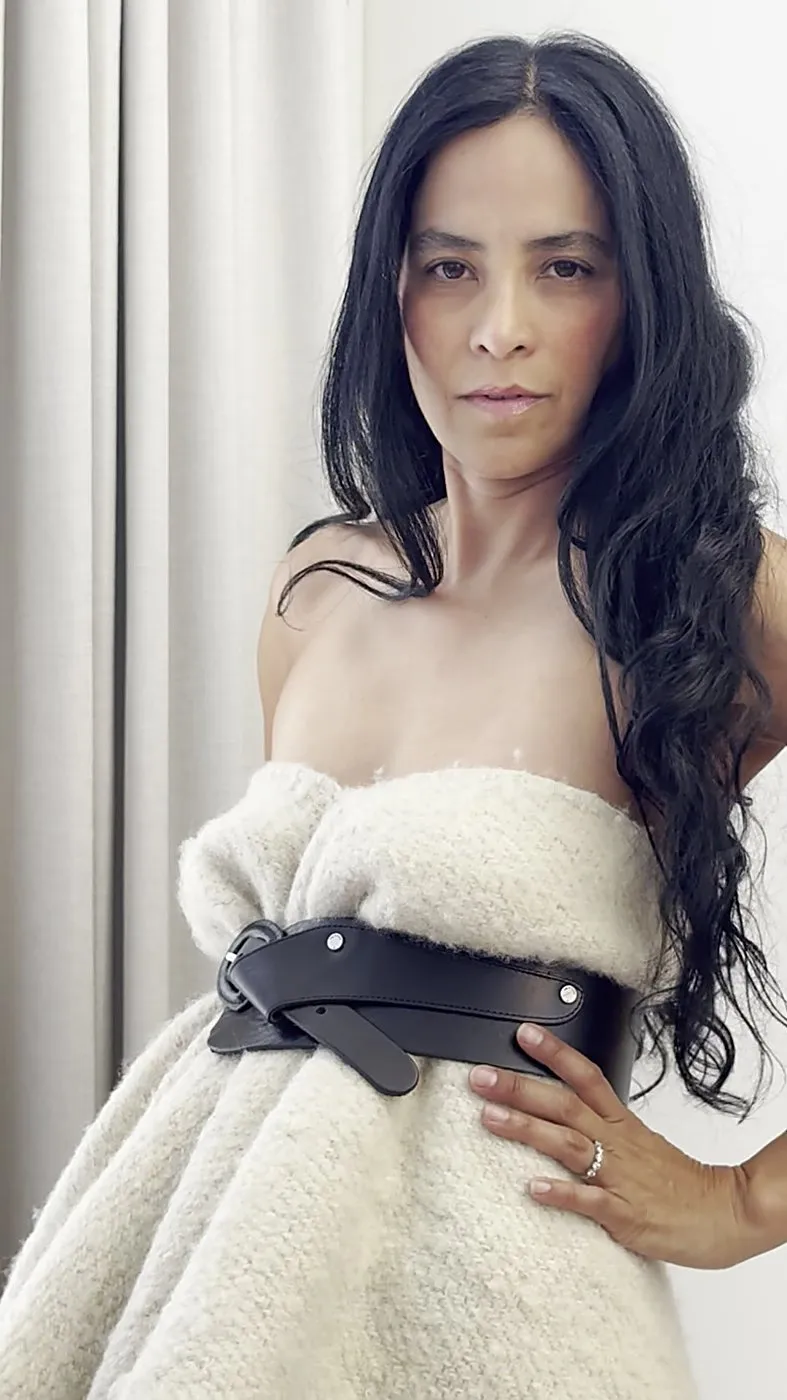
 Belted
The reference point key
A reference point is any place where the garment admits that there's a person inside. There are four classic ones, and you only need one at a time.
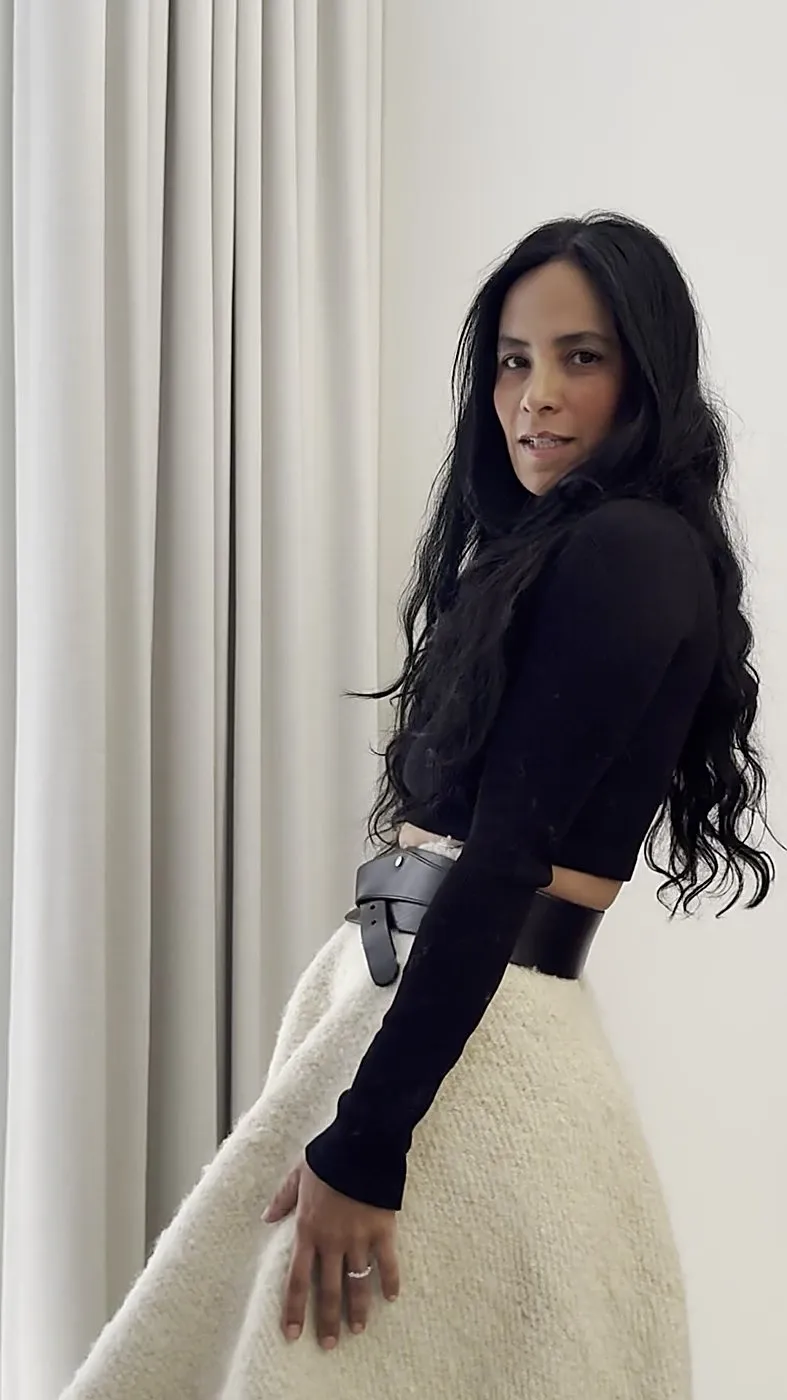 Skirt
 Dress
The waist. A belt over the poncho, at your natural waist or slightly above, instantly turns a blanket into a silhouette. The shoulder. Let the fabric drop off one shoulder or fold it back, and the collarbone does the work. The hand. Push up the sleeves or let a wrist show; a bit of skin at the extremities says 'there's a frame here'. The leg. If the top is wide, the bottom should be defined: slim trousers, a straight skirt, boots with a clean line.
Big with big reads as pajamas. Big with one defined point reads as intention. That's not about bodies; it's geometry, and it works the same at 25 and at 55.
The YB Method, applied
By day, by night and in any season, and the poncho is the best student in the class. Draped over the shoulders, it's a cape: very structured trousers underneath and dark sunglasses, and suddenly you're the woman who arrives at the meeting having already made the decision. Belted at the hips, it becomes a skirt with movement. Pulled up and belted under the bust, it's a dress. Same fabric, three silhouettes, and in every one there's a clear reference point.
The smart-shopping angle is obvious once you see it. A good poncho in a neutral color and a fabric with weight (wool, alpaca, a dense knit) is one of the most versatile pieces you can buy, because it changes shape with a belt. Before you buy, ask the store mirror one question: does it work by day, by night and in any season, and with the rest of my closet? If the answer is yes, it's an investment. If it only works as a hideout, leave it on the hanger.
So go get that big piece you've been hiding in. Add one reference point. You weren't too much for the volume. The volume was just waiting for directions.
Frequently asked questions
Do oversized clothes make you look bigger?
How do you wear a poncho after 40?
What is the rule for wearing oversized clothes?
Can you belt a poncho?
Where does the poncho come from?
Sources and further reading
- The Metropolitan Museum of Art — Poncho, Bolivia (20th century)
- The George Washington University Museum and The Textile Museum — Mapuche Poncho from Chile
- Victoria and Albert Museum — 'Sack' dress, Cristóbal Balenciaga (1957–8)
- The Metropolitan Museum of Art — Cristobal Balenciaga (1895–1972), Heilbrunn Timeline
Read next
The blazer is not a uniform: a short history of a misunderstanding →Neon has no age: the color theory nobody taught you →A logo is an ad: what brand prominence says about you →Sweet and tough: the theory behind a dress and a leather jacket →Beauty is not pain: why comfort is a style decision →Leopard is a neutral: the history of fashion's most misjudged print →The black vest: five ways to wear the garment a king swore would never change →Velvet is not just for the holidays: how to wear a velvet blazer by day →White doesn't expire in September: the truth about no white after Labor Day →The feather skirt is not just for parties: one star piece, three ways to wear it →Leopard on your feet: how to wear leopard print boots with almost everything →One loud piece, quiet basics: how to wear a statement coat without the costume effect →The trench coat is not a raincoat: London and Paris reinvented it (and it's already in your closet) →The corset doesn't squeeze you, it holds you: how to wear one all day without suffering →Loafers are not just for men: five ways to wear them with everything →Turn off the color and texture turns on: what black and white reveals about your style →When your outfit owns every corner: simple is not the same as invisible →Spring 2027 runway trends are already in my closet: what London, Milan and Paris showed →Tailoring that hugs: the black suit, the vest and Milan's cinched waist →The high-low hem is back: my white ruffled dress and London's runways →Leopard is the neutral of 2027: Paris just confirmed it →The evening jacket, now by day: Milan and Paris agree →