

A fisherman's shoe, a student's shoe, everyone's shoe: a short history
Before it was a banker's shoe, the loafer was a fisherman's shoe and then a student's shoe. Women have worn it for decades.
The loafer didn't start in a corner office. It started in Aurland, a village on Norway's Sognefjord, where fishermen wore simple leather slip-ons. Around 1930, a local shoemaker, Nils Gregoriusson Tveranger, turned that idea into a laceless moccasin with a strap across the top. Comfort first, ceremony never.

By 1936, G.H. Bass in Maine had launched its own version, the Weejun, the shoe that set the classic "penny loafer" style. The penny part came later, in the 1950s and '60s, when students started slipping coins into the slit on the strap. So before it was a banker's shoe, it was a campus shoe.
Then came luxury. Gucci released its horsebit loafer in 1953, first for men, and, as W Magazine tells it, women's versions followed. Sophia Loren, Jane Birkin and Jacqueline Kennedy are among the names linked to the brand's shop on Rome's Via Condotti. Translation: women have been wearing loafers for decades. The "men's shoe" story is the one that's out of date.
Why the contrast works: structure under softness
Here's the theory in one line: when everything in an outfit speaks the same language, nothing stands out. A soft, slinky dress with delicate sandals is pretty, but predictable. Put a shoe with weight and structure under it and suddenly the softness of the fabric shows twice as much.
 Silk
 Patent
That's why loafers look so good with exactly the things we were told not to wear them with. Liquid fabrics like silk or satin get grounded. Shiny textures like patent or leather get a counterpart. Sporty details like visible socks get a polished partner. The shoe does the same job a well-cut blazer does over a slip dress: it adds intention.
And there's a bonus nobody mentions. A loafer with a lug sole is a shoe you can walk in all day, and that matters. Looking great and suffering are not the same thing, and at this age we stopped confusing them.
The YB Method, applied: five ways (and more) to wear them
The loafer does the same job a good blazer does over a slip dress: it adds intention.
By day, by night and in any season. That's The Versatility Test, and a good pair of loafers passes it with room to spare. Here's how the same white pair works in five different outfits.
 Standing
 Slit skirt
 Foot up
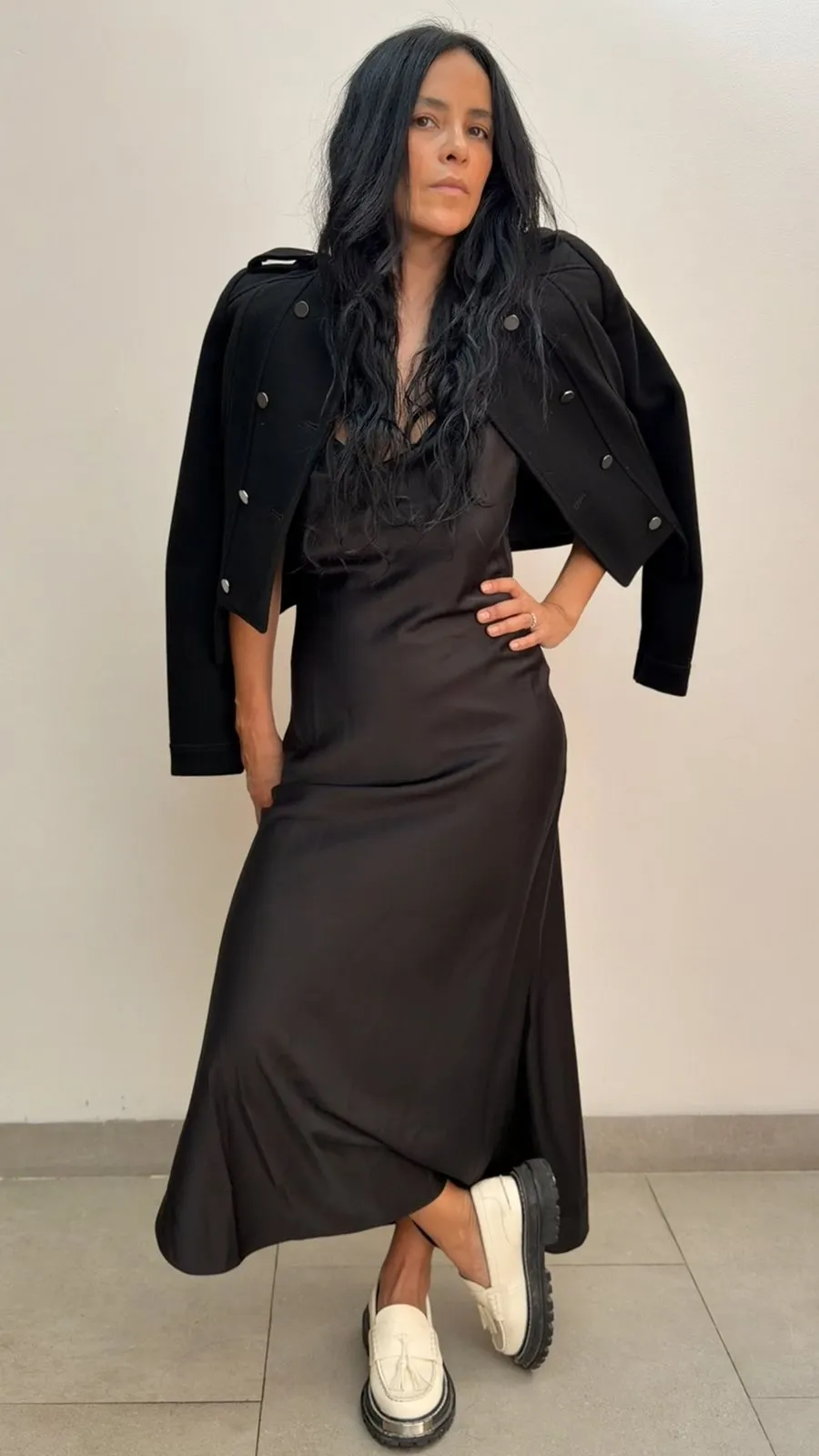
1. With a black silk slip dress. The liquid, sensual drape of the silk meets the firmness of the loafer. The shoe brings the dress down to earth and makes it modern without losing an ounce of elegance. Add a chunky chain and you're done. 2. With a short skirt and visible socks. Here it's a black patent mini with an oversized white shirt off the shoulders. The socks connect the skirt to the shoe and give the whole thing a fresh, playful twist. It's the most surprising look of the five, and the one that turns the most heads.
3. With wide pleated trousers and a cropped top. Black on black with a flash of skin at the waist: the white loafers peek out under the hem and make the trousers look intentional, not like office pants. 4. With a long slit skirt. Sitting, crossing your legs, walking: the slit shows the shoe and the shoe balances the length. 5. With the same slip dress and a cropped jacket. The jacket turns the evening dress into a daytime look in two seconds, and the loafers make sure nobody thinks you got lost on your way home from a party.
Shopping smarter: how to choose loafers you'll actually wear
If you're buying one pair, buy the one that works with a dress, with jeans and with trousers. A few things to check before you pay. The color: white or ivory is the most versatile pair you can own; it lights up black, denim and neutrals alike. Black is the classic, burgundy is the elegant surprise. The sole: a chunkier lug sole adds attitude and comfort; a thin sole is more formal and pairs best with tailoring.

The material: smooth leather is the easiest to wear, patent adds shine for the evening, suede softens everything. The fit: a loafer has no laces to save it, so it has to hold your heel without slipping and without rubbing. Walk around the store for real, not just two steps in front of the mirror. And the question that matters most: can I picture them with a dress, with jeans and with trousers? If the answer comes fast, that's a smarter buy.
Less is more doesn't mean buying less. It means buying better: smarter, more thoughtful shopping. One good pair of loafers, worn with everything, is worth more than five pairs of shoes you save for the right occasion. If you want more on why comfort is part of good design, read Beauty is not pain. So, who said loafers are just for men? Not us.
Frequently asked questions
Can women wear loafers?
How do you wear loafers after 40?
Can you wear loafers with a dress?
What color loafers are the most versatile?
Where do loafers come from?
Sources and further reading
- Gentleman's Gazette — How a Norwegian Fisherman Invented the Penny Loafer
- Encyclopedia.com (St. James Encyclopedia of Popular Culture) — Loafers
- Smithsonian Magazine — The best in fashion history: penny loafers
- W Magazine — The story behind Gucci's horsebit loafer
Read next
The blazer is not a uniform: a short history of a misunderstanding →Neon has no age: the color theory nobody taught you →The poncho is not a hideout: the theory of volume after 40 →A logo is an ad: what brand prominence says about you →Sweet and tough: the theory behind a dress and a leather jacket →Beauty is not pain: why comfort is a style decision →Leopard is a neutral: the history of fashion's most misjudged print →The black vest: five ways to wear the garment a king swore would never change →Velvet is not just for the holidays: how to wear a velvet blazer by day →White doesn't expire in September: the truth about no white after Labor Day →The feather skirt is not just for parties: one star piece, three ways to wear it →Leopard on your feet: how to wear leopard print boots with almost everything →One loud piece, quiet basics: how to wear a statement coat without the costume effect →The trench coat is not a raincoat: London and Paris reinvented it (and it's already in your closet) →The corset doesn't squeeze you, it holds you: how to wear one all day without suffering →Turn off the color and texture turns on: what black and white reveals about your style →When your outfit owns every corner: simple is not the same as invisible →Spring 2027 runway trends are already in my closet: what London, Milan and Paris showed →Tailoring that hugs: the black suit, the vest and Milan's cinched waist →The high-low hem is back: my white ruffled dress and London's runways →Leopard is the neutral of 2027: Paris just confirmed it →The evening jacket, now by day: Milan and Paris agree →