
Where the myth came from
First, a plot twist: the blazer was never an office garment. It started out as sportswear. Nineteenth-century English rowing clubs wore bright, unstructured jackets to row in; the name itself is said to come from those 'blazing' club colors. The office stole it much later, the way offices steal everything fun, and then had the nerve to tell us it was formal.
 With leather shorts
 Over a long shirt
The second half of the story is pure rebellion. In 1966, Yves Saint Laurent presented Le Smoking, the first tuxedo designed for women, in his fall–winter collection. Society was scandalized. Restaurants turned women in trousers away at the door, and the legend goes that one New York socialite, refused entry, simply took the trousers off and walked in wearing the jacket as a very short dress. That is the energy this garment was born with. His partner Pierre Bergé summed it up: "Chanel gave women their freedom. Saint Laurent gave them power."
So no, the blazer's natural habitat is not the conference room. Historically, its habitat is a boat, a scandal and a woman doing whatever she wants.
What tailoring actually does
A blazer does not make you more serious. It makes you more you — with shoulders.
Now the theory. Fashion historian Anne Hollander argued in Sex and Suits (1994) that tailoring doesn't hide the body: it idealizes it. A good jacket draws a clean line from shoulder to hip, gives the torso architecture and lets everything else move. That's why you stand differently the second you put one on. It isn't magic, and it isn't the meeting. It's structure.
Psychology has a name for the rest of the effect. In 2012, researchers Hajo Adam and Adam Galinsky coined the term enclothed cognition: in their experiments, people wearing a lab coat they believed was a doctor's coat performed better on attention tasks than people wearing the same coat described as a painter's smock. Same fabric, different story, different brain. (Science being science, later replications have been mixed — but the core idea that clothes carry meaning inward, not just outward, has held up well enough to take seriously.)
Put those two together and you get the YB position: the blazer is not a costume for pretending to be serious. It's a piece of architecture that changes how you carry yourself. Wasting that on two meetings a year is, frankly, bad engineering.
The YB Method, applied
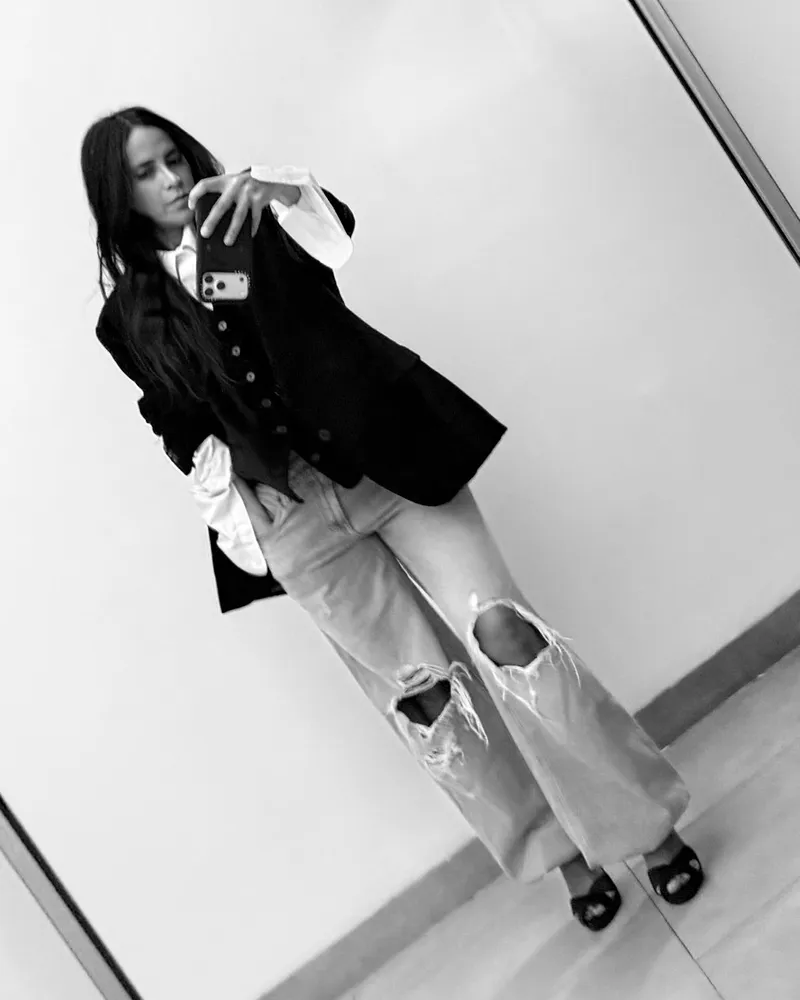
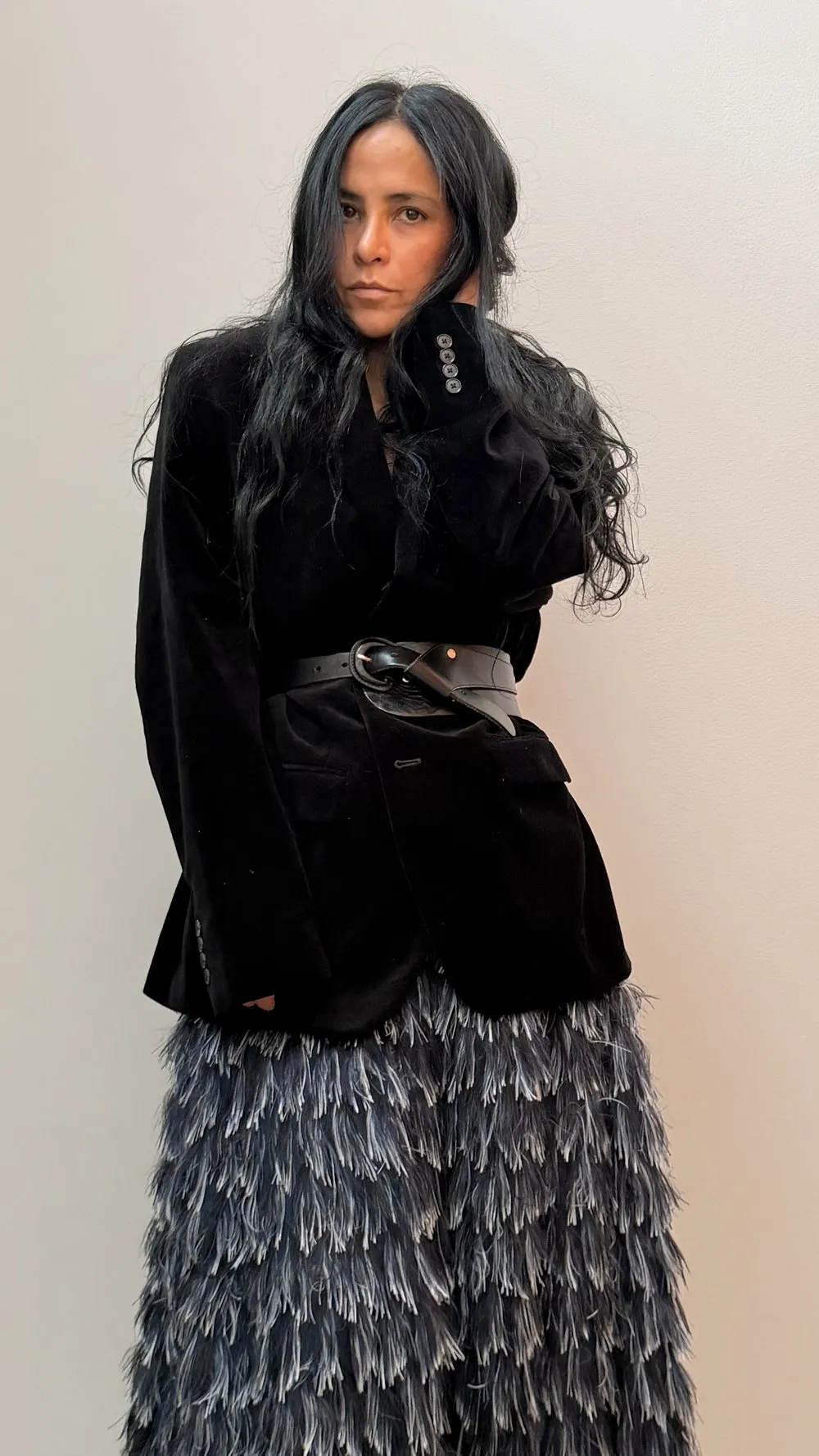
By day, by night and in any season. The same black blazer goes to the meeting with trousers, yes — that one you already know. But it also goes over a white tee and jeans to the supermarket, where it will earn you the suspicious respect of strangers. And it closes over bare skin with a belt at night, at which point it stops being a blazer and becomes a dress with opinions.
 By day
 By night
The formula of three keeps it from tipping into costume: one protagonist, one base that lets it shine, one detail of attitude. If the blazer is the protagonist, the base stays quiet (denim, a plain tee) and the attitude arrives in one gesture — sleeves pushed up, a cuff undone, sunglasses. Proportion does the rest: oversize on top asks for something defined below. Big with big is pajamas; big with something defined is intention.
Buying one like an economist
Here is where we talk about money, because smart shopping is the whole point of this house. Stylists use a boring-sounding tool called cost per wear: price divided by the number of times you'll actually wear it. A $30 blazer worn twice costs $15 a wear. A $150 blazer worn a hundred times — meeting, supermarket, dinner — costs $1.50. The 'expensive' one is the cheap one. Run that math before the fitting room, and suddenly you're not spending more. You're spending better.
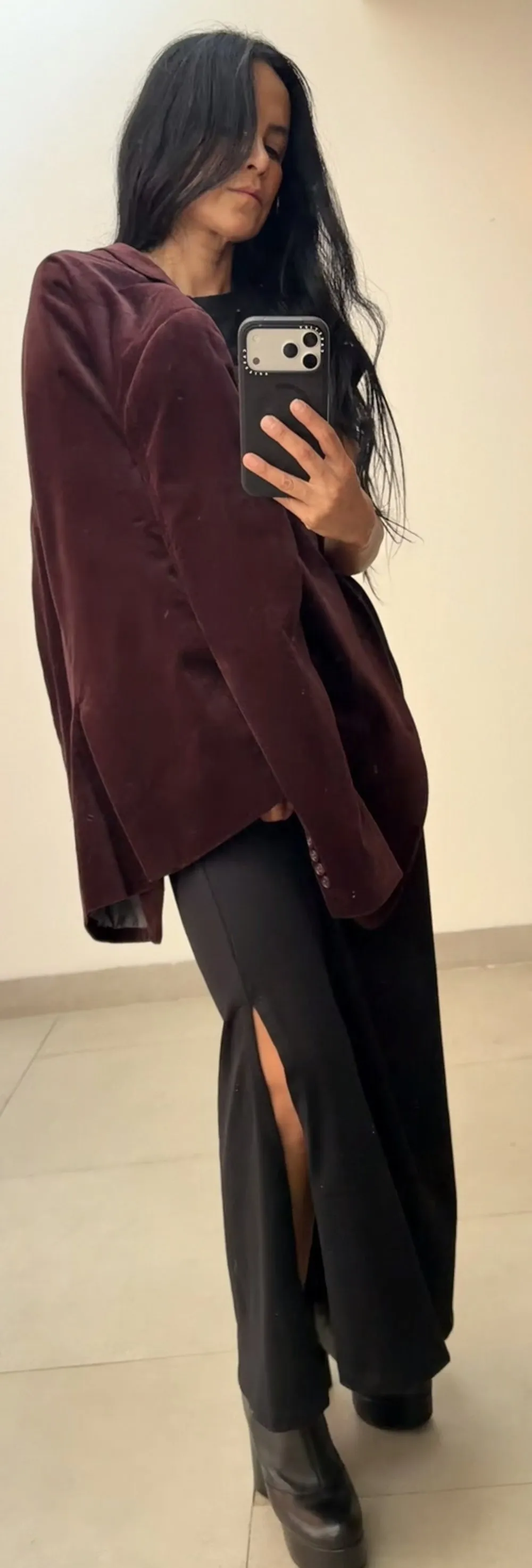
What earns those hundred wears? Shoulder seams that land where your shoulders actually end (or deliberately beyond them, never floating in doubt), fabric with enough weight to hold the line, and a color that already has friends in your closet. Lining and buttons tell you more about a jacket's intentions than its price tag does.
The occasion you're saving it for is not coming. The occasion is Tuesday, and you make it.
Frequently asked questions
Is a blazer only for formal occasions?
What should a woman over 40 look for in her first good blazer?
Oversized or fitted blazer after 40?
How do I make a blazer look less corporate?
How much should I spend on a blazer?
Sources and further reading
- Musée Yves Saint Laurent Paris — Le premier smoking (1966)
- Anne Hollander, Sex and Suits: The Evolution of Modern Dress (1994)
- Hajo Adam & Adam Galinsky, "Enclothed Cognition", Journal of Experimental Social Psychology (2012)
- CR Fashion Book — The History of the Tuxedo
Read next
Neon has no age: the color theory nobody taught you →The poncho is not a hideout: the theory of volume after 40 →A logo is an ad: what brand prominence says about you →Sweet and tough: the theory behind a dress and a leather jacket →Beauty is not pain: why comfort is a style decision →Leopard is a neutral: the history of fashion's most misjudged print →The black vest: five ways to wear the garment a king swore would never change →Velvet is not just for the holidays: how to wear a velvet blazer by day →White doesn't expire in September: the truth about no white after Labor Day →The feather skirt is not just for parties: one star piece, three ways to wear it →Leopard on your feet: how to wear leopard print boots with almost everything →One loud piece, quiet basics: how to wear a statement coat without the costume effect →The trench coat is not a raincoat: London and Paris reinvented it (and it's already in your closet) →The corset doesn't squeeze you, it holds you: how to wear one all day without suffering →Loafers are not just for men: five ways to wear them with everything →Turn off the color and texture turns on: what black and white reveals about your style →When your outfit owns every corner: simple is not the same as invisible →Spring 2027 runway trends are already in my closet: what London, Milan and Paris showed →Tailoring that hugs: the black suit, the vest and Milan's cinched waist →The high-low hem is back: my white ruffled dress and London's runways →Leopard is the neutral of 2027: Paris just confirmed it →The evening jacket, now by day: Milan and Paris agree →